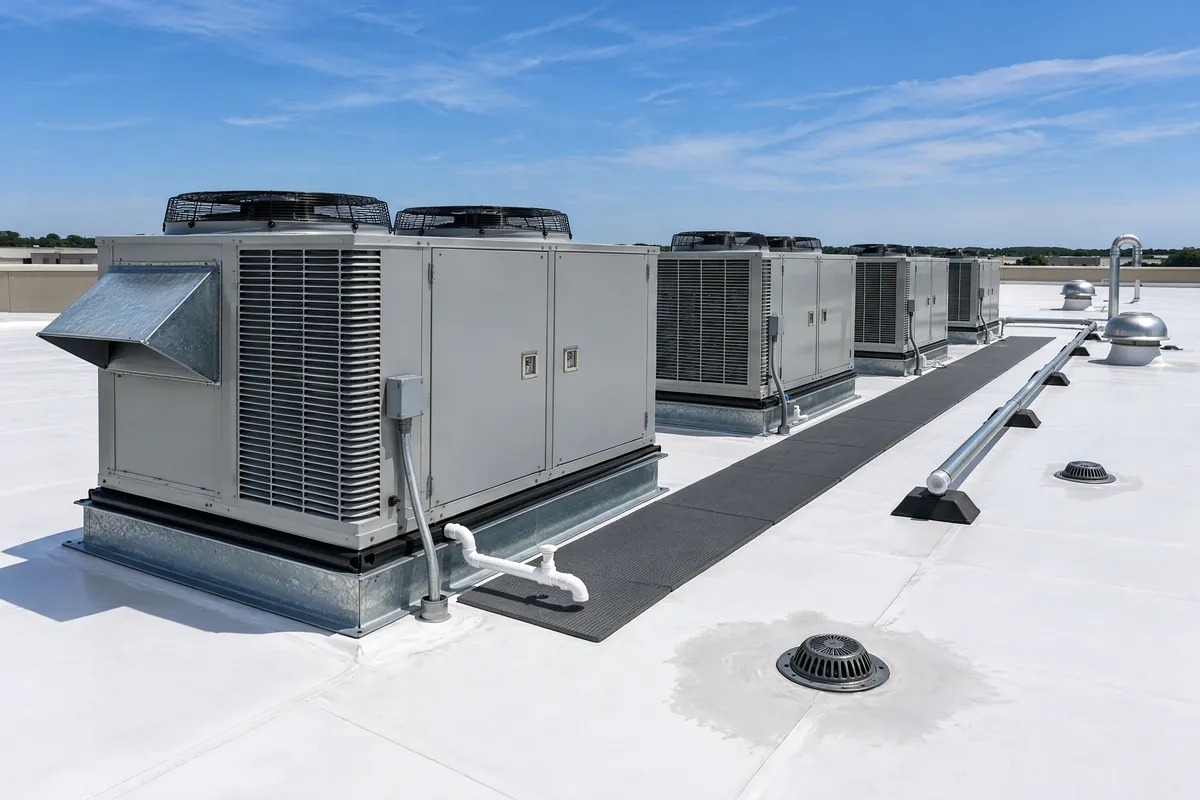
Commercial HVAC covers cooling and heating equipment in offices, shops, restaurants, warehouses and other non-residential buildings, often rooftop units or larger split systems. Not every company in Fort Worth takes commercial work. Call the number on this page to be connected with a local AC company in Fort Worth.
What counts as commercial HVAC
Commercial systems differ from a home central air setup. Many are packaged rooftop units, others are split systems, and some buildings use several smaller units for separate zones. Restaurants and shops may also have refrigeration, which falls under a different license endorsement.
Common reasons to call
- A rooftop unit is not cooling a storefront or office during the Fort Worth summer.
- Tenants are complaining about hot or cold spots.
- A unit is short cycling, icing up or leaking through the ceiling.
- A building owner is planning replacement and wants options and a timeline.
What happens on the call
Describe the building, the type and approximate size of the equipment, and what the problem is. We connect you with an independent local AC company that handles commercial work, and it will say whether your equipment is within its scope. Ask about maintenance agreements, how it handles access to rooftops, and how it will coordinate around business hours. Many companies take after-hours calls; ask when you call.
What it costs
We have no sourced Fort Worth price for commercial work, and we will not invent one. Cost depends on the equipment type, tonnage, roof access and the scope of the job. Ask for a written quote that spells out what is covered, and compare more than one if the job is large. A maintenance agreement may change how repair visits are priced, so ask how that works.
License rules that matter
TDLR's air conditioning and refrigeration rules distinguish between license classes. A Class A contractor license covers units of any size, while a Class B license covers cooling systems up to 25 tons and heating systems up to 1.5 million BTUs per hour. Licenses also carry endorsements, including Environmental Air Conditioning and Commercial Refrigeration and Process Cooling or Heating. Ask which class and endorsement the company holds, and check the license on TDLR's search.
EPA Section 608 requires technicians who service refrigerant-containing equipment to be certified. Building staff should not handle refrigerant or open electrical panels. If a tenant reports a gas smell, clear the space, call 911, then call the gas utility from outside.
Permits
Fort Worth Development Services says changing, moving or repairing mechanical equipment requires a mechanical permit, and applicants must be registered contractors. For larger commercial work, ask the company how it handles permitting.
Commercial HVAC questions from Fort Worth homeowners
Do all AC companies handle commercial HVAC?
What is the difference between TDLR Class A and Class B licenses?
How much does commercial HVAC work cost?
Does commercial work need a permit in Fort Worth?
Related AC and heating services in Fort Worth
Helpful guides
Commercial HVAC in nearby cities and towns
Tarrant County
Johnson County
Parker County
Hood County
Denton County
Wise County
Sources
Last updated: